
🎯Quick Answer: What Are Ducting Hose Accessories?
Ducting hose accessories are the hardware that connects, seals, supports, and grounds flexible duct hose. There are eight families: clamps (worm-drive, bridge, T-bolt, quick-release), cuffs (sewn, belted, funnel, reduced), connectors and couplers (aluminum, stainless, J-lock), adapters and reducers, flanges and gaskets, vibration-isolating flexible connectors, sealing tape and mastic (UL 181A-P / 181B-FX), and hangers and saddles (1.5" minimum width, max 4 ft spacing). Accessories are 5-12% of a typical ducting budget and cause roughly half of all field leaks.
Nobody calls a duct manufacturer to talk about clamps. Buyers call about hose — diameter, material, temperature rating, price per foot. Then the order ships, the crew installs it, and three weeks later we get the photo: a collapsed joint, a hose that walked off a blower flange, a dust collection run leaking at every connection.
In almost every case the hose was fine. The ducting hose accessories were wrong — a worm-drive clamp crushing a wire helix, a hanger strap 3/8 inch wide strangling a 10-inch duct, cloth duct tape doing a job that needed a draw band. Accessories are 5-12% of the material cost of a flexible ducting run and they determine whether the other 88-95% actually works.
This guide covers every accessory family we stock and manufacture, with the sizing rules, torque limits, code references, and 2026 pricing that competing pages leave out.
The 8 Accessory Families at a Glance
Every ducting hose accessory does one of four jobs: grip, join, seal, or support. Confusing these is where specifications go wrong — tape seals but does not grip, a clamp grips but does not join, a connector joins but does not support.
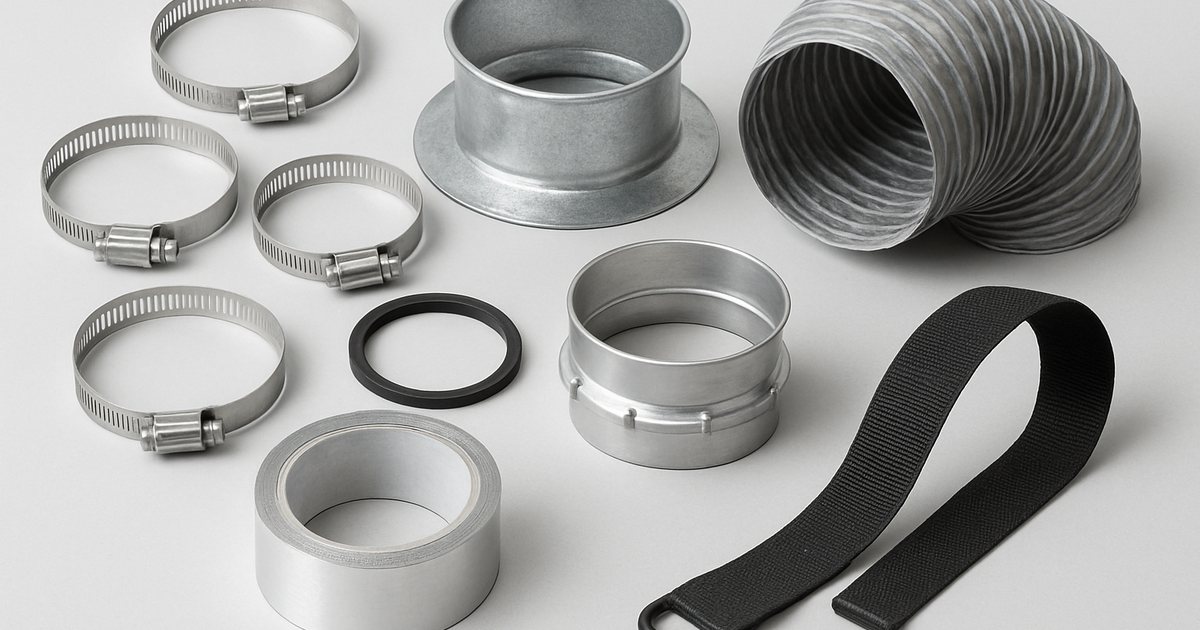
| Family | Job | Common Types | Size Range |
|---|---|---|---|
| Clamps | Grip | Worm-drive, bridge, T-bolt, quick-release | 1.5"–20" |
| Cuffs | Grip + join | Sewn, belted, funnel, enlarged, reduced | 4"–24" |
| Connectors / couplers | Join | Aluminum, stainless, J-lock, draw band | 1.5"–24" |
| Adapters / reducers | Join | Hose-to-pipe, concentric, eccentric, oval | 2"–24" |
| Flanges / gaskets | Join + seal | Steel flange, felt flange, neoprene gasket | 3"–24" |
| Flexible connectors | Join + isolate | Fire-rated fabric, metal-edge, flanged | 4"–6" fabric width |
| Tape / mastic | Seal | Foil tape (UL 181A-P / B-FX), duct mastic | 2"/3" × 150 ft |
| Hangers / saddles | Support | Nylon strap, galvanized strap, sheet saddle | 1"–2" width |
Everything we stock across these families lives in our duct accessories catalog. If you are buying the hose at the same time, the industrial hose range and flexible duct range ship on the same pallet — worth doing, because accessories bought separately are the ones that arrive in the wrong size.
Hose Clamps: Types, Sizing & Torque
Clamps are the accessory people get wrong most often, because the failure is not obvious on installation day. A crushed helix looks fine; it leaks three weeks later when the hose relaxes.
| Clamp Type | How It Works | Use On | Torque |
|---|---|---|---|
| Worm-drive (screw) clamp | Slotted band pulled by a worm screw; uniform radial load | Smooth-wall hose, PVC, PU, light helix | 30–45 in-lb |
| Bridge clamp | Welded bridge spans the wire helix so load lands between wires | Wire-reinforced ducting hose 2"+ | 35–50 in-lb |
| T-bolt clamp | Solid band with a trunnion and bolt; highest, most even clamp load | High-temp silicone hose, pressurized exhaust | 60–90 in-lb |
| Quick-release / lever clamp | Over-center cam lever, no tools | Portable setups, frequent disconnects | Hand-set |
| Draw band / monkey buckle | Wide galvanized band with integrated worm gear | Insulated flex duct over rigid collars | Snug + tape |
Material selection. Zinc-plated carbon steel is fine indoors and dry, and it is the cheapest. Go to 201 stainless for damp environments and 304 stainless anywhere you have washdown, coastal air, chemical fume, or temperatures above about 400°F. On a dust collection line running through a humid Gulf Coast plant, the $2 upgrade from plated to 304 stainless is the difference between a clamp you can loosen next year and one you cut off with a grinder.
⚠️The #1 Clamp Mistake We See
Using a power impact driver to tighten worm-drive clamps on wire-reinforced hose. An impact driver reaches 60-100+ in-lb in under a second — double the safe limit. The band crushes the steel helix flat, the hose wall creases, and that section will never seal again. Use a 1/4" nut driver by hand, stop at 30-45 in-lb, and re-check after 24 hours of running because coated fabric relaxes and loses 10-15% of the initial clamp load.
Sizing rule. Clamps are sized to the outside diameter of the assembled joint, not the nominal hose ID. Nominal ID + 2 × wall thickness + helix height + connector wall = actual clamped OD. On a 6" ID hose that typically lands between 6.4" and 6.8". Always pick a clamp whose adjustment range brackets your measured OD with at least 1/2" of screw travel left — a clamp used at the end of its range applies uneven load and slips.
Cuffs & Hose Ends
A cuff is a factory-finished end on the hose itself, and it exists to solve one problem: connecting a hose to something that is not a round pipe. Cuffs are how you attach a blower hose to a fan housing, a rectangular opening, or another hose section without carrying a bag of hardware.
- Sewn cuff — plain fabric extension beyond the last wire; the standard, cheapest end. Clamp over it.
- Belted cuff — a sewn cuff with an integrated cinch strap. Attaches a ventilator to an opening with no clamp and no tools, which is why rental and emergency ventilation fleets specify it.
- Funnel / enlarged cuff — flares out to a larger diameter so the hose slips over a bigger fan outlet.
- Reduced cuff — necks down so the hose fits inside a smaller port, which eliminates a separate reducer.
- Cuffed-and-clamped end — cuff with the clamp pre-installed at the factory. We ship this on custom runs because it removes the field torque error entirely.
Cuffs are a custom item. We build them to the mating dimension you give us, MOQ 100 pieces per size, 10-15 business days after drawing approval. For one-off jobs, a stock hose plus an aluminum connector and clamp does the same job for less.
Connectors, Couplers & J-Locks
A connector is the rigid sleeve that two hose ends clamp onto. Without one, you are clamping fabric to fabric — which holds for about a week.
| Connector | Material | Max Temp | Best For |
|---|---|---|---|
| Aluminum connector | Spun aluminum | ~400°F | General ventilation, lightweight portable runs |
| Stainless connector | 304 SS | ~1,200°F | Hot exhaust, washdown, chemical fume |
| J-lock connector | Aluminum / steel | ~400°F | Tool-free quarter-turn disconnects |
| Quick-clamp coupler | Galvanized steel | ~350°F | Dust collection with frequent reconfiguration |
| Draw band / monkey buckle | Zinc-plated galv. | ~250°F | HVAC flex duct to rigid collars, 4"–20" |
The J-lock and quick-clamp styles cost 2-3× a plain aluminum sleeve, and they are worth it exactly when the run gets reconfigured. On a woodshop dust collection system that moves with the machines, tool-free connectors pay for themselves in the first month of labor. On a permanent HVAC branch that will be opened once a decade, a plain connector plus tape is the right call. Deeper detail on joint types is in our duct connector guide.
Adapters, Reducers & Transitions
Adapters connect ducting hose to something that is not another hose: rigid spiral pipe, a blast gate, a machine hood, a fan flange, a dryer stub. The standard hose adapter is galvanized steel with one beaded end (the hose slips over it and the bead stops the clamp from walking off) and one rolled lip or crimped end for the rigid side.
Reducers change diameter. Two rules that come straight off our test bench:
- Keep the included angle under 30° (15° per side). A 12"-to-8" reduction therefore needs at least 6 inches of length. Shorter reducers create turbulence, noise, and measurable static pressure loss.
- Use eccentric reducers on horizontal runs where moisture or particulate can settle, so the bottom stays flat and material does not pool at the step. Concentric is fine on vertical runs.
Reducing diameter always raises velocity, and velocity is what drives friction loss and noise. Before you specify a reducer, check the CFM against the smaller size in our flex duct CFM chart — many "we need a reducer" requests are actually undersized-duct problems. Rigid fitting geometry and equivalent-length penalties are covered in the duct fittings guide.
Flanges, Gaskets & Vibration Connectors
Flanges give a hose a bolted, removable connection point — required anywhere a hood, filter housing, or fan needs to come off for service. Steel flanges are the norm; felt-faced flanges are used on hoods where the mating surface is uneven and a compliant face seals better than a rigid one. Pair any bolted flange with a neoprene or EPDM gasket; a metal-to-metal duct flange leaks 3-8% of system airflow no matter how hard you torque the bolts.
Vibration-isolating flexible connectors are a different animal and the one accessory that is genuinely non-optional. Bolt rigid duct straight to an air handler and the fan's structure-borne vibration transmits through the whole duct run, which is where most "noisy ductwork" complaints actually originate. A fire-rated fabric flexible connector with a 4"-6" fabric width breaks that path. The fabric must be fire-retardant to satisfy NFPA 90A, and it must be installed with slack — a connector pulled taut transmits vibration exactly like solid duct and the fabric fails early from fatigue. Full noise workflow: HVAC duct noise reduction.
Sealing: UL 181 Tape vs Mastic
Sealing is the cheapest performance upgrade in ductwork and the most frequently botched. Typical duct systems leak 20-30% of the air they move; sealed joints cut that to under 5%.
| Sealant | Listing | Temp Range | Notes |
|---|---|---|---|
| Aluminum foil tape | UL 181A-P + 181B-FX | -22°F to +302°F | Acrylic PSA, 2"/3" × 150 ft rolls; burnish it down |
| Duct mastic | UL 181B-M | -20°F to +200°F | Best on irregular joints; brush 1/16" wet film |
| Butyl / foil-butyl tape | Varies | -40°F to +200°F | Thick, conformable; good on cold/dusty surfaces |
| Cloth "duct tape" | None | — | Rubber adhesive fails in 12–24 months. Never use on ducts. |
Three field notes: wipe the surface with denatured alcohol before taping (foil tape will not bond to dust or oil film); burnish the tape with a plastic squeegee, because the acrylic adhesive is pressure-activated and unburnished tape peels; and never tape a joint that has not first been mechanically fastened with a clamp or draw band. Tape is a sealant, not a fastener. Detail on sealing methods and test standards: duct sealing guide.
Hangers, Straps & Support Spacing
Support hardware is where code is most explicit and field practice is worst. The rules:
- Maximum spacing 4 feet. The International Mechanical Code requires flexible air duct to be supported at the manufacturer's recommended interval and not more than 4 ft.
- Maximum sag 1/2 inch per foot of spacing between supports. At 4 ft spacing that is 2 inches of allowable belly — more than that and you are adding real friction loss.
- Hanger width 1.5 inches minimum where it contacts the duct, per the Air Diffusion Council flexible duct installation standard. This is the rule everyone skips. A 3/8" wire hanger on a 10" duct pinches the core and can cut effective area by 20-40% at that point — an invisible restriction that shows up only as low airflow at the register.
- Support within 12 inches of every connection and at every change of direction, so the joint carries no hanging load.
Our nylon and galvanized hanger straps ship in 1" and 1.5" widths for 4"-20" duct. For anything over 12" diameter, or any run where the duct will be pressurized above 2 in. w.c., use a formed sheet-metal saddle instead of a strap — it spreads the load over a 90-120° arc instead of a line. Full install sequence: flex duct installation guide.
Grounding & Anti-Static Hardware
If your airstream carries combustible dust (wood, grain, aluminum, sugar, plastics), solvent vapor, or you work in an ESD-controlled area, the accessory list grows by one item that is not optional: bonding hardware.
Anti-static ducting hose works by giving static charge a path to ground through a conductive helix or a carbon-loaded wall. That path breaks at every joint where a fabric cuff, a rubber sleeve, or a painted flange interrupts continuity. The fix is a grounding clamp on the helix at each end plus a bonding jumper across the joint, and then verification with a meter — not assumption.
- NFPA 77 treats a resistance to ground of less than 1 × 10⁶ ohms as adequate for static dissipation bonding.
- NFPA 652 / 654 require documented bonding and grounding of all conveying equipment in combustible dust systems.
- Measure joint-to-ground resistance at commissioning and log it. On a dust hazard analysis, an undocumented ground path is a finding.
We supply grounding clamps and pigtail jumpers matched to our conductive hose. Background reading: anti-static duct guide and ATS conductive duct.
Sizing & Compatibility Chart
Use this to order accessories against a nominal hose ID. Clamped OD values are typical for wire-reinforced ducting hose over a connector; measure your actual assembly if the wall is unusually heavy.
| Hose ID | Typical Clamped OD | Clamp Range | Hanger Width | Tape Width |
|---|---|---|---|---|
| 4" | 4.3"–4.6" | 3.5"–5.5" | 1.5" | 2" |
| 6" | 6.4"–6.8" | 5.5"–7.5" | 1.5" | 2" |
| 8" | 8.4"–8.9" | 7.5"–9.5" | 1.5" | 3" |
| 10" | 10.5"–11.0" | 9.5"–11.5" | 1.5"–2" | 3" |
| 12" | 12.5"–13.1" | 11.5"–14" | Saddle | 3" |
| 16" | 16.6"–17.3" | 15"–18" | Saddle | 3" |
| 20" | 20.7"–21.5" | 19"–22" | Saddle | 3" |
2026 Pricing: Retail vs Factory-Direct
Accessory margins are the least transparent part of this market. Below are current US online-retail ranges for common sizes against our factory-direct contractor pricing at 500 pieces per SKU.
| Item | Online Retail (each) | Factory-Direct @ 500 pcs | Saving |
|---|---|---|---|
| Bridge clamp, 2"–12" | $8.29–$21.19 | $3.40–$9.10 | ~57% |
| Worm-drive screw clamp, 1.5"–12" | $9.20–$38.00 | $2.90–$14.50 | ~62% |
| Aluminum connector, 4"–12" | $21.15–$52.00 | $9.50–$24.00 | ~54% |
| Stainless connector, 4"–12" | $30.27–$50.59 | $14.00–$25.00 | ~52% |
| J-lock connector, 4"–20" | $46.20–$70.91 | $22.00–$36.00 | ~50% |
| UL 181 foil tape, 2" × 150 ft | $18–$32/roll | $8.50–$12/roll | ~55% |
| Nylon hanger strap, 1.5" × 100 ft | $22–$40/roll | $11–$18/roll | ~52% |
Retail ranges reflect published US online prices for comparable stock sizes as of September 2026. Factory-direct figures are FOB Brookshire, TX at 500 pcs per SKU and exclude freight. Bulk flex duct pricing is broken down separately in our wholesale flexible duct pricing guide.
💡Where the Money Actually Is
Contractors negotiate hard on hose price per foot and then buy accessories at retail from the nearest supply house. On a 5,000 ft ducting package that habit costs $4,000-$7,000 a year in clamps, connectors, and tape alone. Put accessories on the same purchase order as the hose — same pallet, one freight charge, contractor pricing on both.
Accessory Kits by Application
What you actually need to order, by job type. These are the bills of material we build most often.
| Application | Accessory Kit | Watch Out For |
|---|---|---|
| Residential HVAC flex duct | Draw band, start collar, UL 181B-FX tape, 1.5" nylon hangers | Sag over 1/2"/ft; narrow hangers pinching the core |
| Woodshop dust collection | Bridge clamps, quick-clamp couplers, blast gate adapters, grounding jumpers | Broken ground path at every fabric joint |
| Welding fume extraction | T-bolt or 304 SS clamps, stainless connectors, steel flange + gasket | Aluminum connectors too close to the arc; plated clamps corroding |
| Portable AC / spot cooling | Quick-release clamps, funnel cuff, window adapter plate | Uninsulated hose sweating; oversized clamp slipping |
| Grow room ventilation | Worm-drive clamps, inline fan adapters, acoustic hangers, foil tape | Clamping over insulation and crushing the inner core |
| Commercial AHU connection | Fire-rated fabric flexible connector, flanges, gaskets, saddles | Connector installed taut — transmits vibration, fails early |
Hose selection for each of these is covered in the industrial flexible duct guide, the dust collection duct guide, and the portable AC exhaust hose guide.
What to Send Us for a Quote
Accessory quotes bounce back with questions more than any other line item, because "6-inch clamps" is not a specification. Send these six things and you get a firm number and correct parts on the first pass:
- Hose ID and construction — nominal diameter, wall material, and whether it is wire-reinforced or smooth-wall
- Measured OD of the assembled joint, if you have a sample in hand (this beats any chart)
- What the hose connects to — spiral pipe, hood, fan flange, blast gate, machine port — with that part's dimension
- Air temperature and what is in the airstream (this sets material: plated, 201 SS, or 304 SS)
- Positive or negative pressure, and how often the joint will be opened
- Quantity per size, and whether you need any combustible-dust bonding documentation
🎯Manufacturer Recommendation
Buy accessories with the hose, from whoever makes the hose. We build every clamp, connector, and cuff quote against the actual OD of the hose we are shipping you — which is the one number a general supply house does not have. Stock sizes 1.5"-20" ship from Brookshire, TX in 1-3 business days with no minimum; custom cuffs and adapters run MOQ 100 pcs at 10-15 business days.
Frequently Asked Questions
Frequently Asked Questions
What accessories do I need for flexible ducting hose?
What is the difference between a bridge clamp and a screw clamp?
How tight should I torque a duct hose clamp?
What size clamp do I need for 6-inch ducting hose?
Can you use regular duct tape on ducting hose joints?
How far apart should flexible duct hangers be spaced?
Do I need grounding accessories for anti-static ducting hose?
What is the minimum order quantity for ducting hose accessories?
Related Guides
- Duct Connector Guide: Types, Sizes & How to Join Duct
- Duct Fittings: Elbows, Tees, Reducers & Transitions
- Duct Sealing Guide: Tape, Mastic & UL 181 Listings
- Flex Duct Installation Guide: Support, Sag & Sealing
- Air Hose Guide: Materials, Sizing & Fittings
- Anti-Static Duct Guide: Conductive Materials & NFPA 652
- Shop Duct Accessories: Connectors, Tape, Hangers
Request a Quote for ducting hose accessories (clamps, connectors, cuffs, tape, hangers)
Fill in your requirements. We respond within 24 hours on business days.